
Checking Criminal History in Long County
Begin with the record custodian, not with a broad name search. The Long County Sheriff's Office can supply sheriff reports and local-only history. The clerk at the Long County Courthouse holds filed cases and certified dispositions. The Georgia Crime Information Center, or GCIC, keeps the state criminal-history repository. Each answers a different question, so the best route depends on whether the goal is a recent police contact, a court outcome, or a state history review.
Gather the full name, date of birth, and any case, incident, or citation number first. Spelling matters. A search based on a common name can point to the wrong person, while a local report may be indexed by event number rather than name.
- Ask the sheriff or Ludowici Police for the report created by the local agency.
- Contact the correct court clerk for charges, hearings, and the final disposition.
- Use Georgia Felon Search only when a final Georgia felony conviction is the target.
- Check the correct host jail, GDC, or federal locator when present custody is the question.
- Order a certified court copy or personal GCIC review when the result must be confirmed.
Long County's Three-Office Record Check
Long County criminal records split across the sheriff, court clerk, and GCIC. The sheriff's file shows what deputies recorded and processed. A clerk file shows what prosecutors filed and how a judge resolved it. GCIC links reported arrest cycles to final dispositions, but reporting delays or unmatched data can leave gaps. Comparing all three is especially useful when reviewing your own record.
| Channel | Best for | Key limit |
|---|---|---|
| Long County Sheriff | Local reports, warrants, GCIC requests | A local-only search is not statewide |
| Court clerk | Filed charges, orders, disposition, certified copies | No complete local public docket was verified |
| GCIC | Reported Georgia criminal history | Scope varies by product and authority |
The official sheriff homepage shows the local office identity and current services.
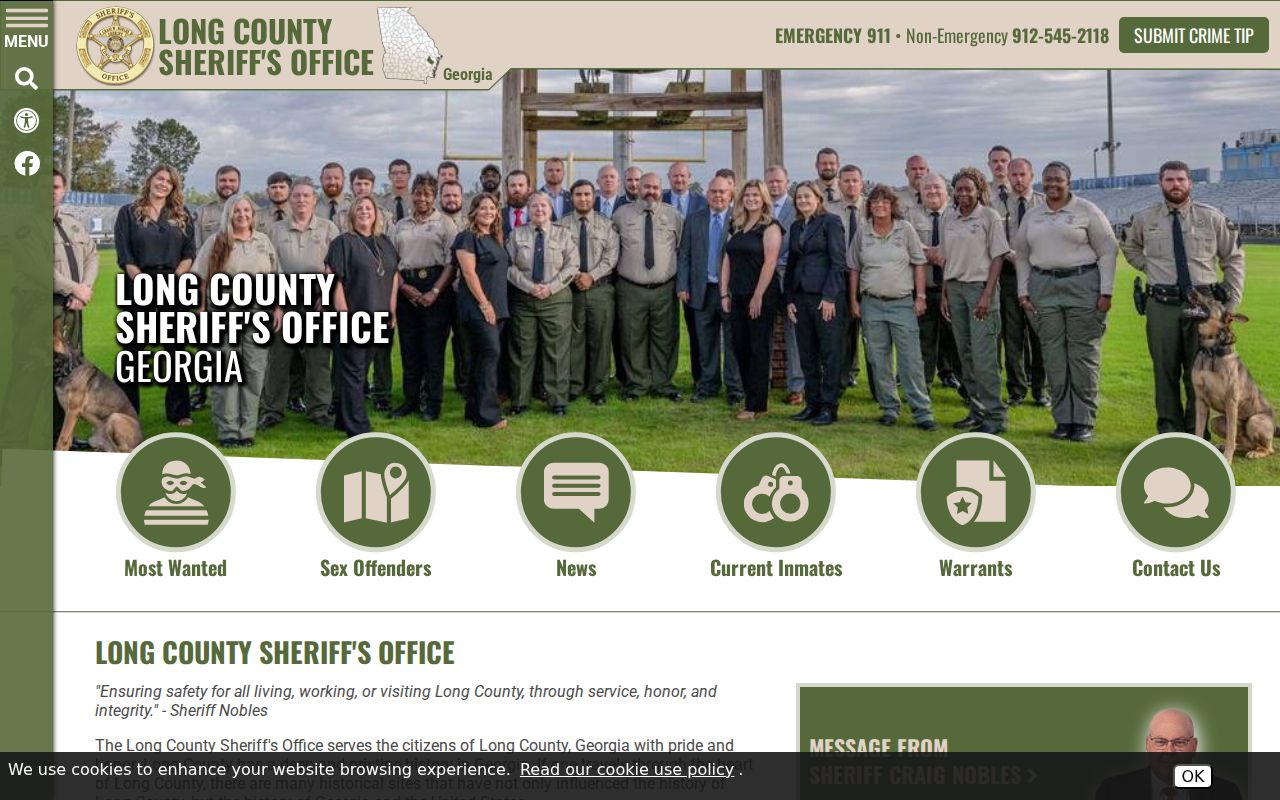
That office remains the practical first call when a Long County record begins with a deputy, warrant, or booking.
Georgia Official Background Checks
The Georgia Bureau of Investigation operates GCIC. Its public Georgia Felon Search accepts a first name, last name, date of birth, and sex. It costs $15 per search and reports final felony convictions held by GCIC. It is not a full local incident search, a complete court docket, or proof that no other record exists.
Long County Sheriff's Office also provides a $20 cash GCIC report in person. The requester must show identification and provide the required identifiers. A notarized consent is required for another person's broader history except where Georgia permits the felony-only public route. Fingerprint-based reviews begin through Georgia Applicant Processing Service. No verified GAPS enrollment site sits in Long County, so use the state location search before travel.
The state felony search form illustrates the narrow input set.
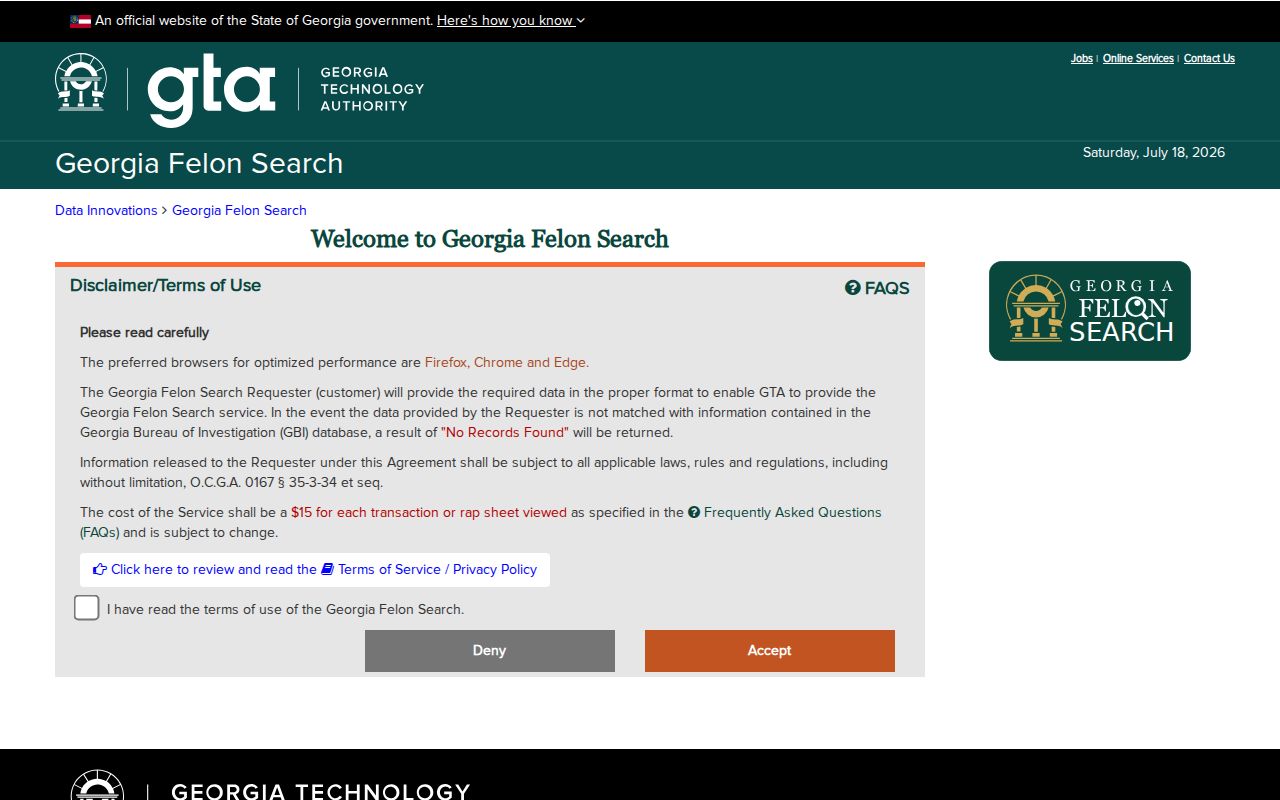
Its simple form should not be mistaken for every record layer kept in Long County.
Long County's Cash GCIC Check
The sheriff's records counter at 6 East Academy Street in Ludowici provides a distinctly local GCIC channel. The office lists a $20 fee, payable in cash, and says processing generally takes three business days. Bring government identification. The request asks for name, sex, race, date of birth, and Social Security number. When the search concerns someone else, the notarized consent rule applies unless the request falls within the felony-only exception.
| Service | Cost | Access |
|---|---|---|
| Long County GCIC report | $20 cash | Sheriff's office; ID and consent rules apply |
| Georgia Felon Search | $15 per search | Online; final felony convictions only |
The Long County GCIC instructions show the fee and request conditions.
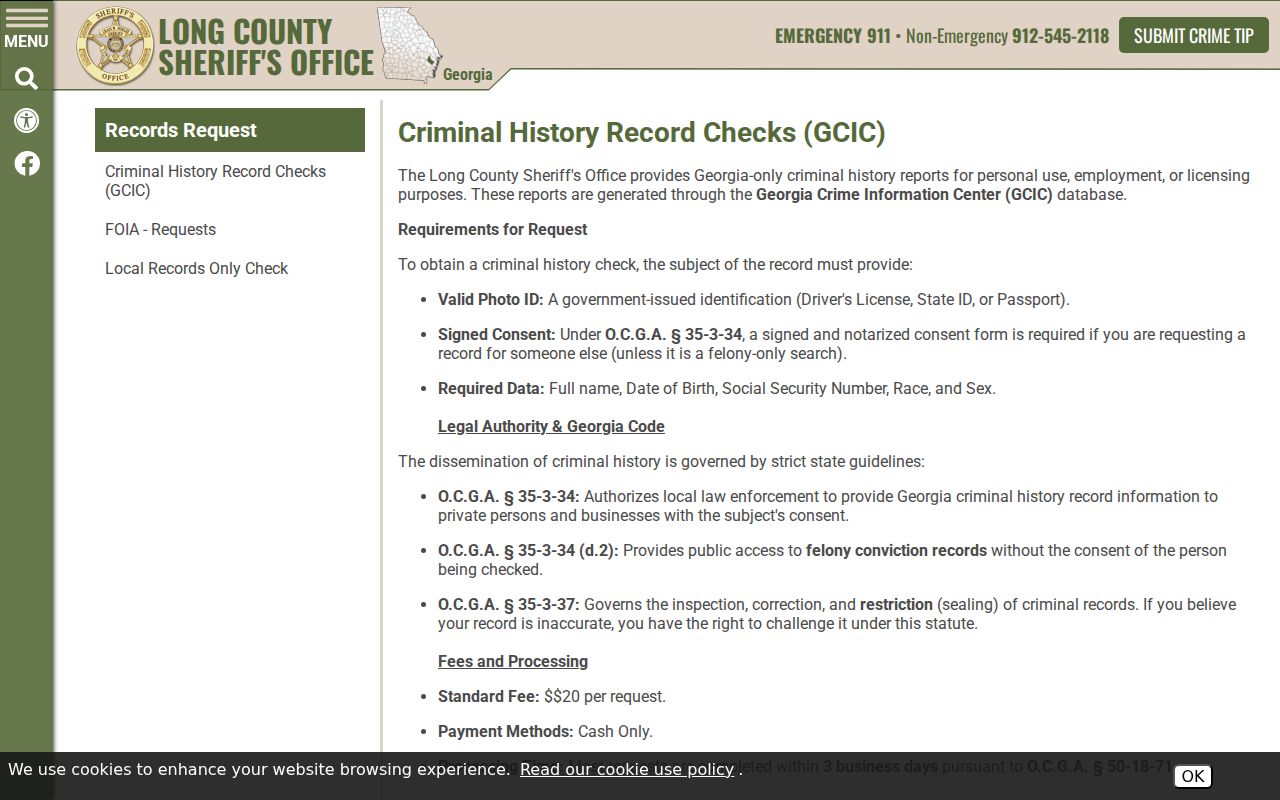
Those published terms make the sheriff counter more useful than an unsupported web search for a local official report.
Criminal Record Types
A single event may produce several Long County records. A deputy or Ludowici officer writes the report. The sheriff processes the person and arranges outside housing because Long County has no operating jail. A prosecutor decides what charge to file, and the appropriate clerk opens the case. Fingerprints and final outcomes may later reach GCIC.
- Police and arrest reports: agency accounts of an incident and enforcement action.
- Court files: accusations, indictments, motions, pleas, orders, and dispositions.
- Criminal-history entries: arrest cycles matched to reported outcomes in GCIC.
- Warrants: court authority administered through the warrant clerk and issuing court.
- Custody and supervision: host-jail, GDC, probation, parole, and registry records.
Ownership controls access. The sheriff cannot give a court date or resolve a filed case, and a court clerk does not maintain the state's full rap sheet.
Long County Arrests Leave the County
A fire damaged the courthouse jail in the early 1980s, and it was never restored. Long County now sends detainees to Tattnall, Liberty, or Ware County. That history creates a split file: LCSO holds the Long County arrest, hold, and bond information, while the host sheriff holds present custody, mail, and facility details. Call LCSO at (912) 545-2118 before searching a host jail.
A Long County hold must still be addressed through LCSO even when the person is physically housed elsewhere. The same split explains why a generic Long County inmate search may fail. State-sentenced custody is different again and belongs in GDC Find an Offender.
The GDC search guidance notes that a surname may need four letters and that some photos are unavailable.
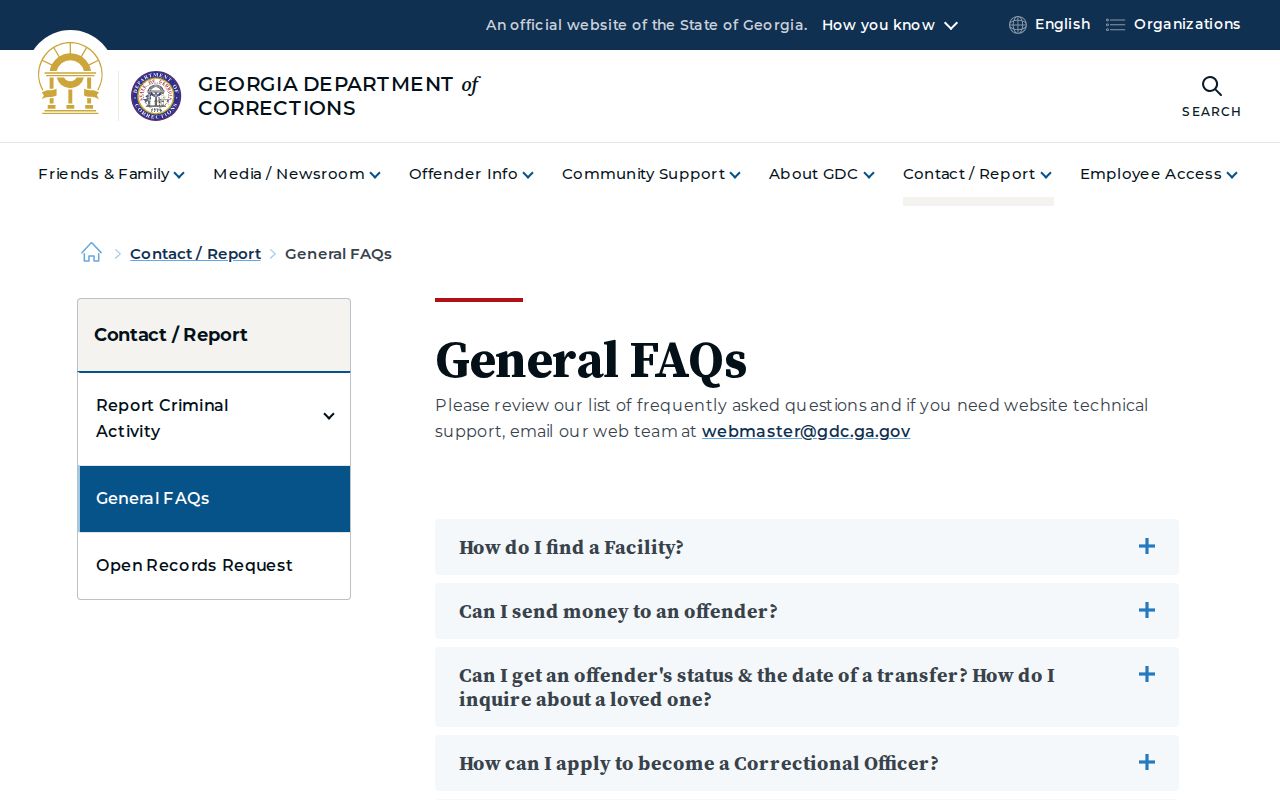
That locator serves sentenced state custody, not the neighboring jail that may hold a new Long County arrest.
Inside a Long County Criminal Record
Read each field in context. An arrest date does not show guilt. A charge is the allegation used at that stage, and the prosecutor may amend it. The disposition tells how the court ended the charge. Sentence and supervision fields appear only after a qualifying outcome, and custody status may be held by another agency.
| Name and identifiers | Name, aliases, date of birth, sex, race, and an agency or state identifier when released. |
|---|---|
| Arrest data | Arresting agency, date, booking or incident number, and initial allegations. |
| Court data | Case number, filed charge, court, hearings, pleas, and orders. |
| Disposition | Dismissal, acquittal, plea, conviction, no bill, or another final result. |
| Sentence | Custody, probation, fines, or other terms ordered by the court. |
| Current status | Host-jail custody, GDC custody, DCS supervision, or parole status where applicable. |
A certified disposition from the clerk is often the soundest source when GCIC appears to lack the outcome of a Long County case.
Long County Warrant Checks
No official public Long County warrant name-search was verified. Use the sheriff's warrant information, contact the warrants clerk, and check with the court that issued the order. Bench warrants arise from court proceedings, while Magistrate Court handles arrest-warrant applications and preliminary matters. Do not rely on an unknown caller or payment demand as proof of a warrant.
The sheriff directs people who learn of an active warrant to arrange a safe surrender. Mary Cooper is listed as warrants clerk at the sheriff's main number. A court clerk can address the case record and scheduled appearance, but only the judge sets or changes bond.
The official warrant workflow presents the surrender and court-routing path.
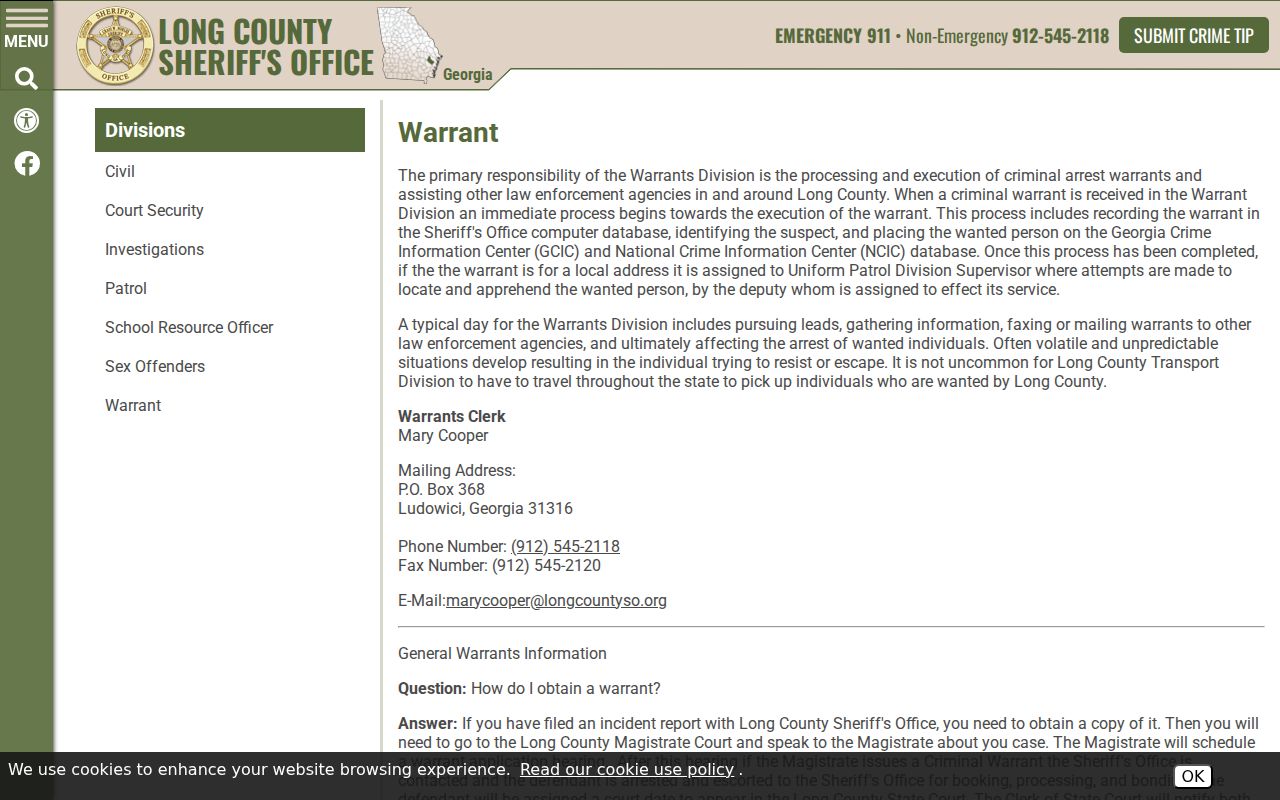
Verify every warrant and bond instruction through those published Long County contacts.
Public Access Laws in Georgia
The Georgia Open Records Act governs access to many sheriff and local government records, but exemptions can protect active investigations, confidential sources, juvenile material, and information restricted by another law. Court records follow court custody and sealing rules. GCIC criminal-history dissemination is governed separately, so an open-records request is not a way around consent or statutory access limits.
Key Georgia laws:
O.C.G.A. §§ 50-18-70 through 50-18-77 establish the Georgia Open Records Act and its response framework.
O.C.G.A. § 35-3-35 controls dissemination of Georgia criminal-history information.
O.C.G.A. § 35-3-37 governs eligible record restriction and related sealing.
Georgia juvenile-record law limits access to protected juvenile files.
Describe the record, date range, and incident or case number in a request. The Act calls for a response within three business days when practical, but that is not a promise that every file will be produced within three days.
Correcting Long County Record Gaps
If your GCIC history lacks a Long County disposition, first obtain the certified outcome from the clerk at 459 McDonald Street. Compare the case number, charge, arrest date, and identifiers with the state entry. Then use the GBI correction channel and provide the supporting court record. The clerk answers what happened in the case; GCIC addresses the repository entry.
- Disposition
- The final result for a charge, such as dismissal, acquittal, plea, or conviction.
- No bill
- A grand jury decision not to indict on the presented charge.
- Nolle prosequi
- A prosecutor's formal choice not to continue a charge at that time.
- Certified copy
- A clerk-authenticated court record used to prove the official filed result.
Matching the right arrest cycle matters. Similar names alone are not enough to establish that the record belongs to you.
Sealed, Expunged, and Restricted Records
Georgia calls its process record restriction, not simple deletion. Under O.C.G.A. § 35-3-37, eligible arrest records may be limited from noncriminal-justice access. Eligibility depends on the outcome and other statutory conditions. A court record can require a separate sealing order, so a restricted GCIC entry does not automatically remove every public court document.
The sheriff's forms index provides local restriction material. Start with the arresting agency and prosecutor path stated on the current form, and verify the filed court record after any order. First Offender Act discharge is a different mechanism and should not be treated as the same process.
Note: Review the current official form before filing because eligibility, routing, and required attachments depend on the specific arrest cycle.
Long County Custody Record Layers
Custody searches follow the agency that holds the person. New Long County detainees may be in a neighboring county jail. People serving Georgia prison sentences appear through GDC. Federal custody uses the Bureau of Prisons locator, and federal court files use PACER. These systems do not substitute for one another.
The Bureau of Prisons Inmate Locator is the federal custody channel.
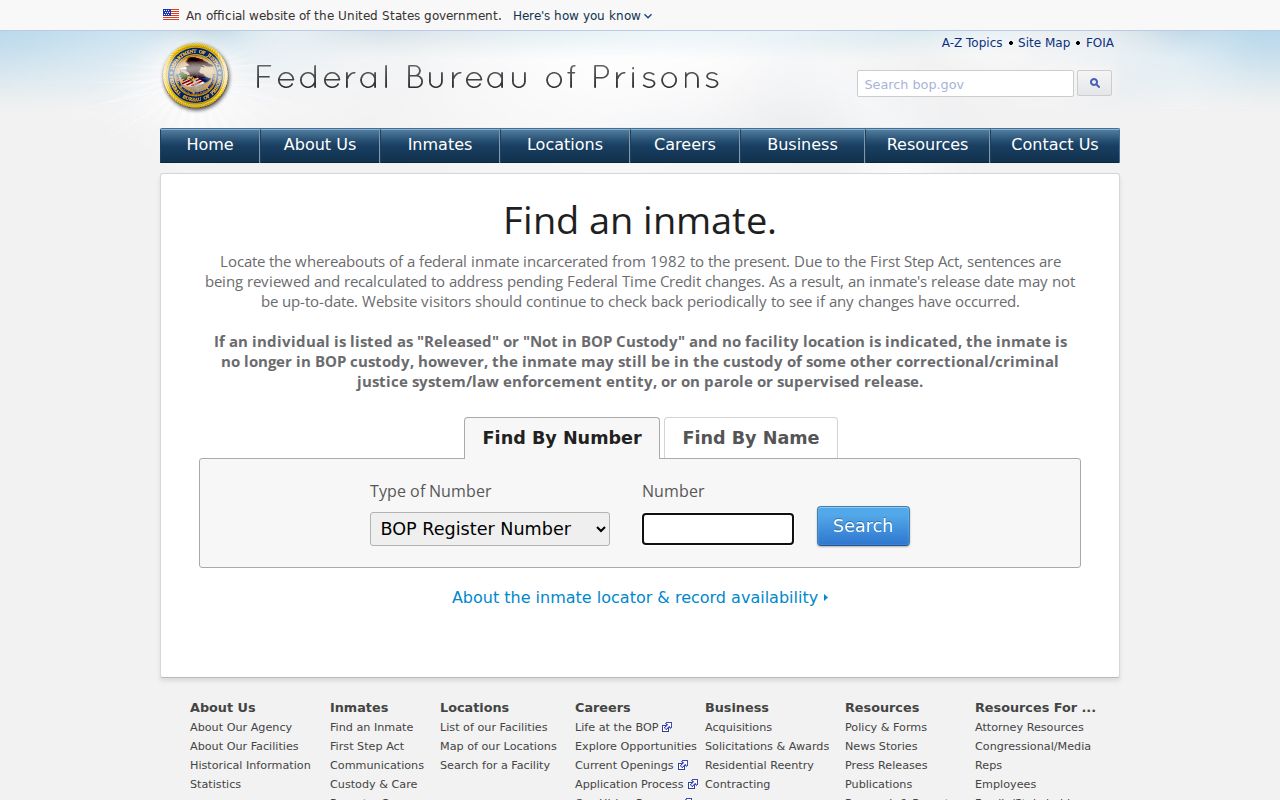
A federal result should then be matched to the case through the federal court record rather than a Long County clerk file.
The PACER system supplies federal dockets and filings.
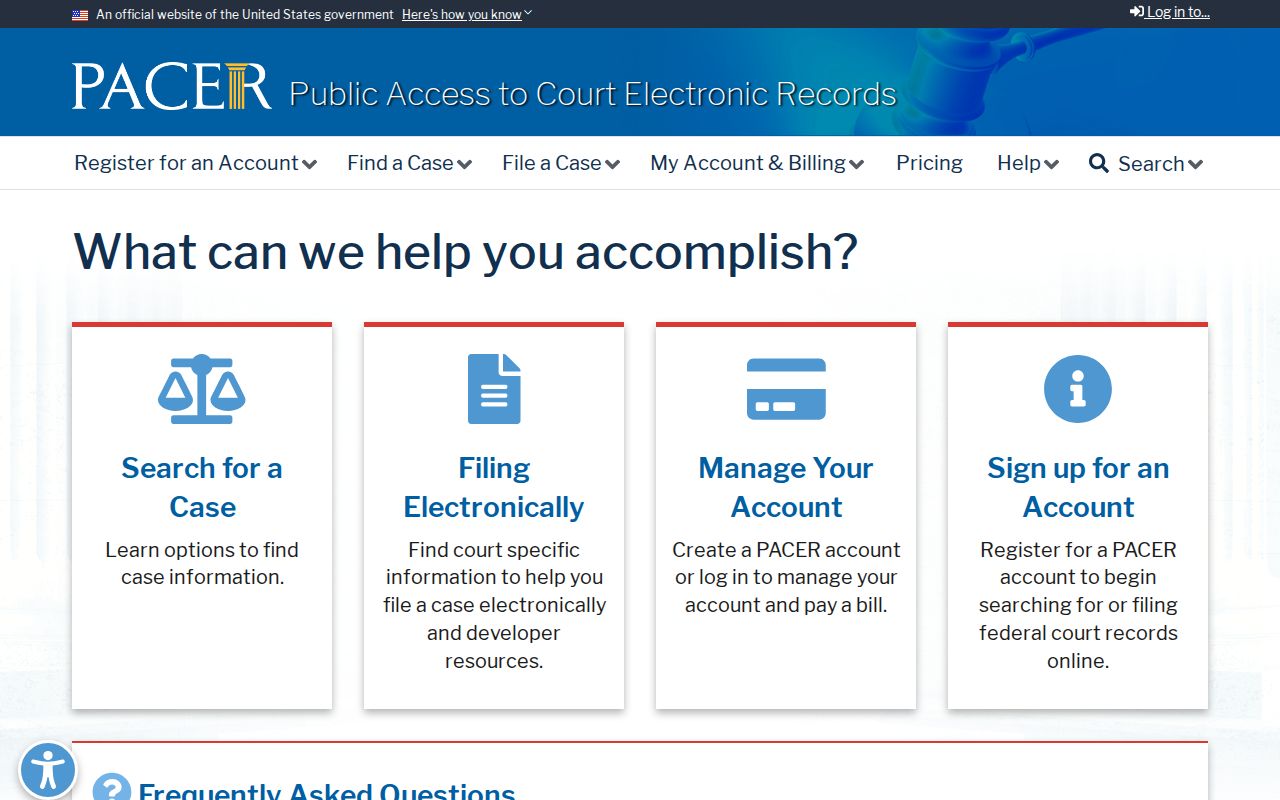
Long County lies in the Southern District of Georgia, so that district is the local federal court layer.
The Southern District of Georgia court site provides official court contacts.
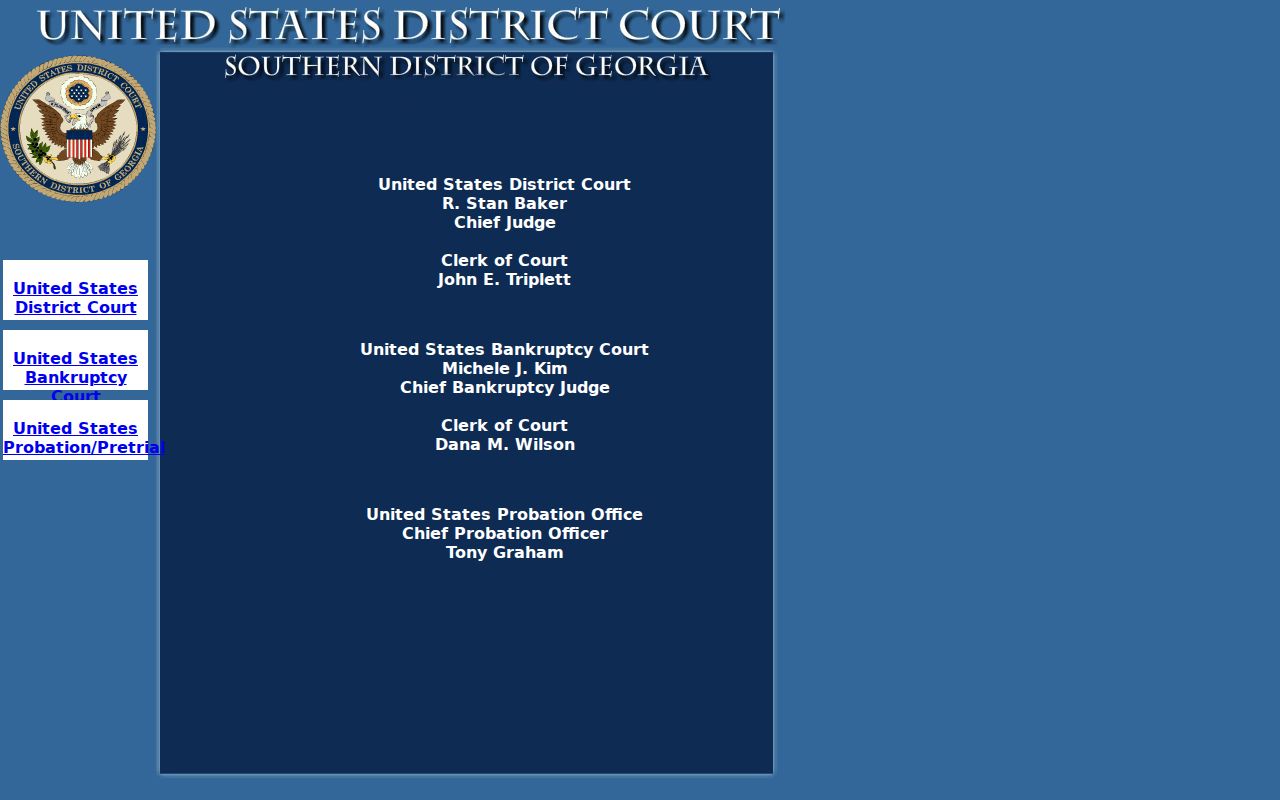
Use the federal channels only when the matter truly falls under federal jurisdiction.
Long County Probation and Parole Records
The Georgia Department of Community Supervision handles adult felony probation and parole field supervision. The Georgia State Board of Pardons and Paroles makes parole decisions. Long County separately identifies misdemeanor probation for State Court matters. A court disposition may show the sentence, while the supervising agency holds current compliance and field-supervision data.
Start with the sentencing court when the question concerns the order itself. Use DCS for adult felony supervision and the Parole Board for parole authority. Some supervision information is limited for safety and privacy reasons.
A Long County court file can state that probation was imposed, its length, and the terms written into the sentence. It may not show each later field contact or the most current supervision event. Parole is distinct from probation. Parole follows a prison sentence and depends on a decision by the State Board of Pardons and Paroles. Felony probation begins with the sentencing court's order and is supervised by DCS. Misdemeanor probation questions belong with the Long County State Court channel identified by the county. Keeping those paths separate prevents a searcher from treating a sentencing entry as a live supervision report.
Long County Criminal Records by City
Ludowici is Long County's only incorporated city. Its police department creates city incident and arrest reports, and Municipal Court handles ordinance and traffic matters within city jurisdiction. Felonies move to Long County Superior Court, while county misdemeanors and DUI matters go to State Court. The city layer is therefore useful, but it never replaces the county and Georgia record checks.
Ludowici Criminal Records
City police reports, Municipal Court citations, and routing into Long County courts.
The official county department directory is the current contact source for Ludowici Police and municipal offices.