
Long County Arrest History
The Long County Sheriff's Office handles county patrol arrests and keeps its own reports. Ludowici Police Department creates city arrest and citation records. Georgia State Patrol keeps its enforcement records for highway and DUI arrests, while GBI or GDC personnel may create records in the investigations or correctional matters they handle. The office that made the arrest is the best source for its narrative and case number.
Long County arrest history is not one file stored in one place. An agency report documents the event; sheriff processing creates identity, fingerprint, charge, hold, and bond entries; a host jail creates an intake record; and a clerk creates a case only if a charge reaches court. GCIC later connects reported arrest and disposition data. Each source answers a different question, and none by itself proves the outcome.
The split matters when reviewing an older Long County arrest. A report may explain why an officer acted, the booking entry may list the first allegation, and the later docket may show an amended or dismissed charge. Compare arrest dates, case numbers, and identifiers across those records. A name match alone cannot establish that every file belongs to the same person or that the initial booking charge remained the charge prosecuted in court.
Long County Bookings Cross County Lines
Long County does not operate a jail. The courthouse jail burned in the early 1980s and was never restored, so a person processed on a Long County arrest may be housed at Tattnall County Jail, Liberty County Jail, or Ware County Jail. That is why searching only for a Long County roster will fail even when custody is current.
The official Long County jail and bonding notice explains this host-facility arrangement.
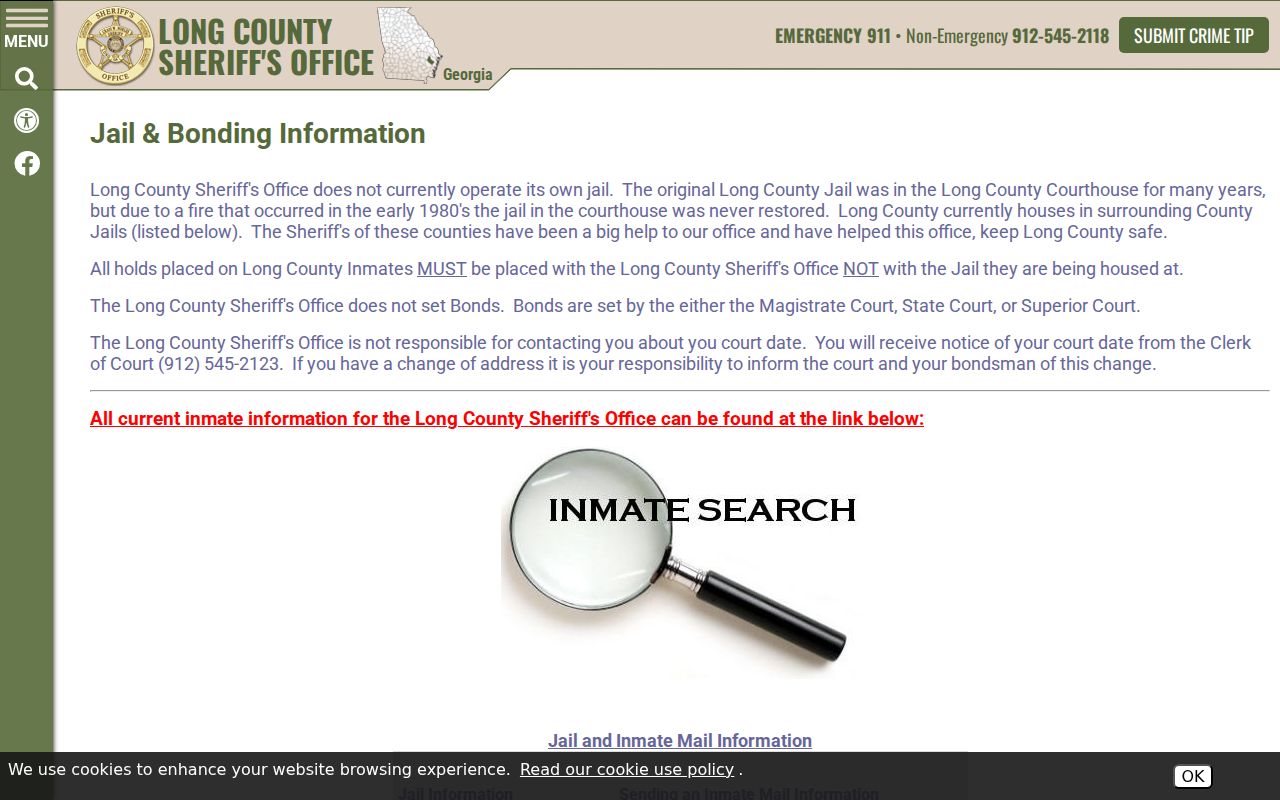
The notice makes the key split plain: the host jail controls housing services, but all Long County holds remain with LCSO and courts set bond.
Looking Up Long County Arrests
No single online Long County booking search exists. Use a name, approximate arrest date and time, arresting agency, and case number if known. The fallback chain below covers every documented channel and helps separate a recent custody question from a report, court case, or statewide history request.
- Call LCSO at (912) 545-2118. Confirm that the event is a Long County matter, ask whether processing is complete, and obtain the name of the host jail.
- Contact the named Tattnall, Liberty, or Ware jail for current intake or release status. The host controls visitation, deposits, telephone service, and identification rules.
- Ask the arresting agency for its incident or arrest report. LCSO accepts focused requests at its counter, by mail, fax, or the records clerk email; Ludowici and state-agency records stay with their creators.
- Call the Long County Clerk at (912) 545-2123 to learn whether charges were filed, which court owns the case, and when a hearing is set. Review the resulting Long County criminal court case separately.
- For a Georgia history product, request a local GCIC report or use Georgia Felon Search for its narrower final-felony scope. GDC Find an Offender applies only when a state sentence puts the person in GDC records.
Long County Reports Take Their Own Path
LCSO assigns a unique case number to an investigation, and evidence is tagged to that number. Deputies typically complete reports within three working days. A useful request identifies the case number when available, date, time, location, involved party, and exact record sought. The sheriff's investigations page documents that report lifecycle.
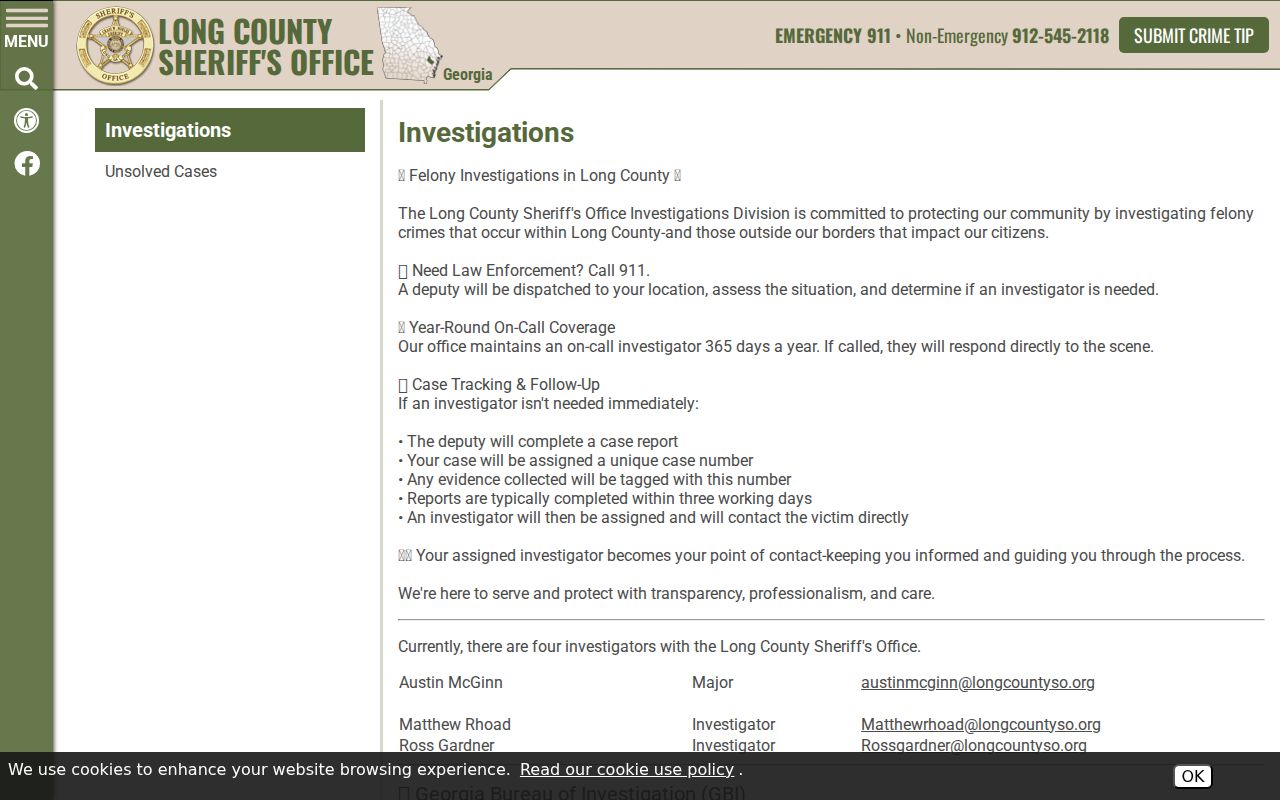
This timing describes ordinary report completion, not a promise that all material is public. Active-investigation content, juvenile records, confidential victim details, and protected identifiers may be withheld or redacted.
Long County Sheriff's Office Records
6 E. Academy Street
Ludowici, GA 31316
(912) 545-2118
Shannonfox@longcountyso.org
Administrative hours: Monday through Friday, 8:00 a.m. to 5:00 p.m.
Inside a Long County Arrest Record
The detail depends on whether the document is the agency report, sheriff processing record, or host-jail intake. A Long County arrest record can identify the event and allegation, while later court entries show what prosecutors filed and how the case ended. Victim, witness, juvenile, and sensitive identifying data can be redacted.
| Case or Booking Number | The arresting agency's unique case key or the host jail's intake identifier. |
|---|---|
| Arrest Date and Time | When the custody event occurred, which helps distinguish people and incidents. |
| Arresting Agency | LCSO, Ludowici Police, Georgia State Patrol, GBI, GDC, or another authorized office. |
| Charges | Alleged arrest offenses and statutes; filed court charges may later differ. |
| Bond or Hold | The court-set bond and any Long County hold administered through LCSO. |
| Booking Photo | A processing image, when lawfully available, that proves only that booking occurred. |
| Custody Status | Host placement, release, or transfer information available from the holding facility. |
One Long County Arrest, Four Records
The record flow explains why details may not match at first. The arresting officer writes an incident and arrest report. LCSO processes fingerprints, the alleged charge, warrant or hold, and bond paperwork. A neighboring jail then logs intake and housing. Finally, a Long County court creates a docket when a prosecutor files a charge.
Record flow: Agency report → LCSO processing → Host-jail intake → Court case → GCIC disposition update.
Fingerprint data travels through GCIC and NCIC channels, while the clerk later reports the final disposition. A delay, missing fingerprint match, or late disposition can leave the layers out of sync. Someone reviewing their own Long County arrest record should compare the report, clerk file, and GCIC self-review before seeking a correction or record restriction.
Booking Logs and Recent Arrests
LCSO publishes neither a daily arrest blotter nor a Long County inmate roster because the county has no jail. Its quarterly reports under O.C.G.A. §§ 42-4-14 and 42-4-16 concern a defined statutory reporting duty, not a public list of all recent arrests. The practical recent-arrest search is a phone-first process.
Call LCSO, obtain the host location, then ask that jail for the current intake entry. A host roster, if offered, is a snapshot of custody and may stop showing a person after release or transfer. Absence from Tattnall, Liberty, or Ware does not prove that a Long County arrest did not occur. The report and any later clerk case are the durable sources.
Long County Holds and Bond Channels
A host jail cannot clear a Long County hold, and LCSO does not set the bond. Magistrate, State, or Superior Court sets it. LCSO accepts cash bond by cash, money order, or cashier's check, with a separate nonrefundable $20 state-required bond fee paid in exact cash. In-county property bond requires the owners to appear with government identification and proof of value. Out-of-county property needs approval from both sheriffs.
There is no bonding company based in Long County, though LCSO lists approved firms from the surrounding area. A surety company charges its own nonrefundable premium. Verify custody and the approved payment route at (912) 545-2118. The sheriff warns against anyone demanding CashApp, Venmo, gift cards, cryptocurrency, or wire transfers for release.
Long County Arrests and GDC Custody
GDC Find an Offender is not a recent Long County booking log. It searches people in or formerly in the state corrections system using name, physical description, GDC ID, or case number. GDC suggests trying the first four letters of the surname and selecting all offenders when a narrow search fails.
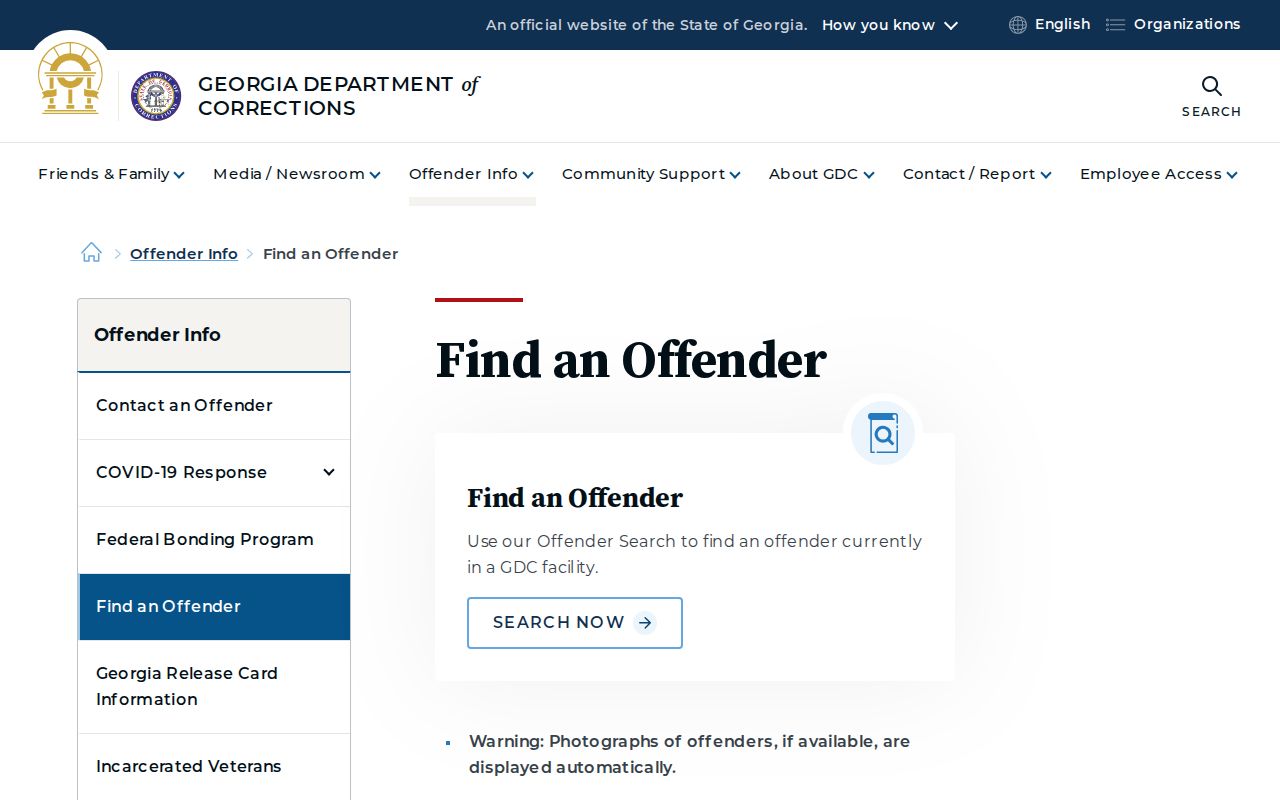
The locator becomes relevant after a state sentence, not during short-term processing in a host jail. GDC notes that its data can be incomplete and directs verification questions to Inmate Records.
Arrests Are Not Convictions
A Long County arrest shows that an agency took a person into custody or began the arrest process on an allegation. It does not show that the prosecutor filed the same charge or that a court found guilt. The prosecutor may decline or amend the case, a grand jury may return no bill, and the court may dismiss, acquit, accept a plea, or enter judgment.
| Arrest Record | Conviction Record |
|---|---|
| Created by the arresting agency, LCSO processing, and host jail. | Created by the court after a plea, trial, or other adjudication. |
| Shows an arrest or booking happened on an allegation. | Shows a court entered a finding or accepted a guilty plea. |
| Kept in agency, sheriff, host-jail, and GCIC arrest-cycle records. | Kept by the clerk and reported through Georgia disposition channels. |
| May lead to release, no charge, dismissal, acquittal, or a filed case. | May lead to sentence, appeal, First Offender treatment, or later relief. |
Note: An arrest is not proof of guilt, and the court disposition must be checked before drawing any conclusion.